Artwork #1
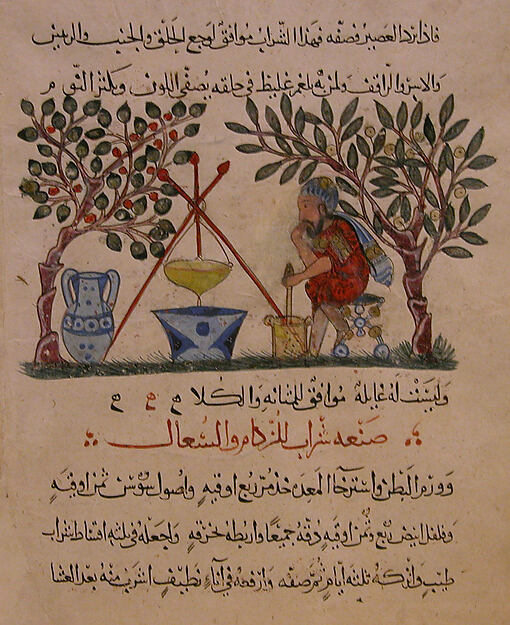
1) "Physician Preparing an Elixir", Folio from a Materia Medica of Dioscorides (Iraq; A.D. 1224)
This artwork shows a figural book painting which had started in the Islamic world as an art form in the late Abbasid Iraq of the 13th century. The translation of a Greek manuscript shows a physician making some type of medicine.
2) The audience would be people living in or near Iraq. Especially Muslims.
3) The artist is attempting to bear witness to the Iraqi culture and how medicine was first made in the earlier centuries.
4) The beauty of this artwork is that the artist used different colors in the piece and also the fact that Arabic text is included which makes it all the more unique.
5) This artist probably wasn't aware of the second artist's art making tradition since this was made before the second painting.
6) I think non-European art does deserve to be placed in the mainstream story of art, because just like European art, non-European art beautifully shows art work from different cultures from different periods of time.
Artwork #2

1) Manuscript Leaf with the Agony in the Garden and Betrayal of Christ, from a Royal Psalter (Great Britain A.D. 1270)
2) The audience would most likely be Europeans. Especially the Christians.
3) The artist is attempting to bear witness psalms from the Old Testament.
4) The artist representation of beauty in this painting is of course the different shades of colors used and how well the scenes from Christ's Passion are shown.
5) The artist was probably aware of the other artist's art making tradition considering this was made years after the first painting. They both show two different religions.
6) I think European art does deserve its place in mainstream story of art because the artworks were made with different types of styles and in a different period of time. It's giving us a sense of knowledge of what is going on in the art.

Excellent comparison of very similar works. You could write a book just comparing these two illuminated manuscript pages.
ReplyDeleteThis is a period where the Middle East, and Baghdad in particular, were the leaders in scientific, mathematical and cultural advancement. Europe and the UK were struggling to emerge from hundreds of years of chaos and the loss of much of the knowledge passed down from the Greeks and Romans.
It was Egyptian and Iraqi scholars who saved the teachings of people like Aristotle and Socrates, as well as passing along advances in medicine, etc. (as your first artwork testifies to).
They passed this knowledge through conventional cultural interchange, especially from the al-Andalus kingdom in Southern Spain. We are also at the height of the European religious crusades, which represent a cultural interchange of sorts (gulp).
Although these artists couldn't have known of each others' existence, your two chosen works represent two societies that were developing a rich and sometimes painful cultural interdependence.
You compare the narrative of each picture, which is a good idea. The British one tells a religious story, while the Iraqi page represents a scientific study.
You could also compare them along formal lines; How do the two artists represent the leaves on their trees differently, for instance?
Or think about the materials that the two artists used. Were they both working on dried animal skin? Where did they get their pigments (colors)? The story of their materials as well speaks volumes about the priorities of their cultures and the lines of trade during this time....
Well done!
(A)