Saturday, May 17, 2014

Class #10 Followup

Manifesto

  1. You must share your discoveries (food, any cures, supplies) with the rest of the group - we are kind of going extinct here ya' know. Can't have anyone being selfish. 
  2. Keep calm, we'll get out of this mess. 
  3. Take turns keeping watch. Protect our little clan! 
  4. Be nice. We don't like mean, rude or obnoxious people 
  5. Don't let your survival skills get to your head. No one cares how good you are at hunting for stuff. Well, we do care, but still don't be annoying about it. 
  6. Always shower. No one likes smelly, unhygienic people.  

Class #9 Followup

Sea City 2000

I really liked the Sea City 2000 because it seemed really advanced. It's really cool how they are using solar panels for energy and using a natural source for energy. This city is basically on an island and that's why it's more sought out to be a perfect place to be. An island is completely secluded from the world and it's like a getaway. This Utopia has everything we need to survive and it's great so that we don't have to have much contact with outside cities. 

Saturday, May 3, 2014

Class #8

Blast to the past: 20's style 


The Author of the Book "Fourteen Letters of Christ" in His Home

Johannes Baader. The Author of the Book "Fourteen Letters of Christ" in His Home. (1920)
MediumCut-and-pasted gelatin silver prints, cut-and-pasted printed paper, and ink on book pages
Dimensions8 1/2 x 5 3/4" (21.6 x 14.6 cm)
In this photomontage, Baader presents a photograph of a domestic space in which various Dada ephemera hangs on the wall at upper left. A figure has been cut out of the center of the photograph to reveal the image of Baader's dummy exhibited at the Berlin Dada Fair in 1920. This work is, in fact, a sophisticated self-portrait of Baader in his persona as the "Oberdada," a parody of a high-ranking military figure (ex.Oberleutnant) of the Dada "troupes." The figure cut out of the upper photograph can be identified as Baader himself, as his reflection is visible in the mirror at the right edge of the cutout.

Man in Top Hat

Elie Nadelman. Man in Top Hat. c. 1920-24
Medium: Painted bronze
Dimensions: 26 x 14 3/4 x 13 1/4" (66 x 37.6 x 33.4 cm)

Untitled (fec.)

Kurt Schwitters. Untitled (fec.). 1920

MediumCut-and-pasted printed paper and pencil on paper on board

Dimensions: 9 7/8 x 7 1/4" (25.1 x 18.2 cm)

Pippin House, East Liverpool, Ohio

Charles Burchfield. Pippin House, East Liverpool, Ohio. (1920)

MediumWatercolor and gouache on paper

Dimensions26 x 19 3/8" (66 x 49.2 cm)

 Burchfield worked predominantly in watercolor. He felt that this was a medium that was preferable to oil paint because it was fast and easier to work with.

The way that these four pieces relate to each other is that they are from the same time period, the 1920's. They all depict how it was during those times, the way people dressed and just basically how everything looked. They were all made by different artists, but these artists knew what they wanted to represent in their artwork. Each artist used their own imagination and their own knowledge on how to show what the 20's was like. 
The audience for my exhibition isn't aimed at a particular group, but I guess it'll mainly attract people who lived during those times attention and the attention of people at this day and age who want to know more about the culture back then.  

Class #7

Artwork #1


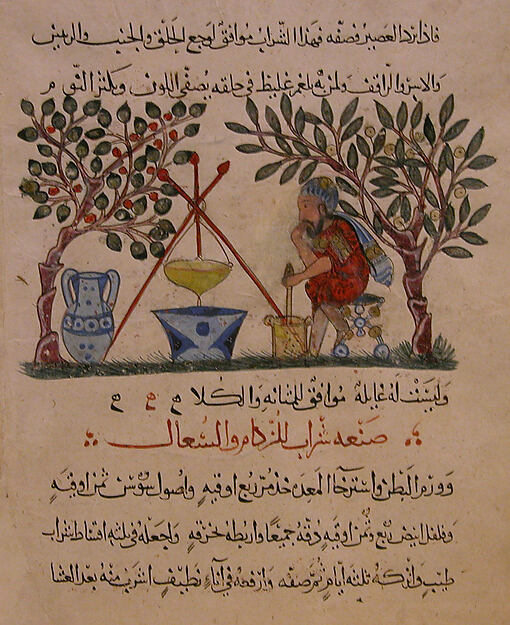
1) "Physician Preparing an Elixir", Folio from a Materia Medica of Dioscorides (Iraq; A.D. 1224)
This artwork shows a figural book painting which had started in the Islamic world as an art form in the late Abbasid Iraq of the 13th century. The translation of a Greek manuscript shows a physician making some type of medicine.

2) The audience would be people living in or near Iraq. Especially Muslims.

3) The artist is attempting to bear witness to the Iraqi culture and how medicine was first made in the earlier centuries.

4) The beauty of this artwork is that the artist used different colors in the piece and also the fact that Arabic text is included which makes it all the more unique.

5) This artist probably wasn't aware of the second artist's art making tradition since this was made before the second painting. 

6) I think non-European art does deserve to be placed in the mainstream story of art, because just like European art, non-European art beautifully shows art work from different cultures from different periods of time. 

Artwork #2

Manuscript Leaf with the Agony in the Garden and Betrayal of Christ, from a Royal Psalter

1) Manuscript Leaf with the Agony in the Garden and Betrayal of Christ, from a Royal Psalter (Great Britain A.D. 1270)

2) The audience would most likely be Europeans. Especially the Christians. 

3) The artist is attempting to bear witness psalms from the Old Testament. 

4) The artist representation of beauty in this painting is of course the different shades of colors used and how well the scenes from Christ's Passion are shown. 

5) The artist was probably aware of the other artist's art making tradition considering this was made years after the first painting. They both show two different religions. 

6)  I think European art does deserve its place in mainstream story of art because the artworks were made with different types of styles and in a different period of time. It's giving us a sense of knowledge of what is going on in the art.