Sunday, June 8, 2014

Class #11: Symbolizing your society and hw


Strength and Infinity Manifesto
Jaylene, Munazza, and Ashley's Survival Group

Our flag symbolizes strength and unity within the group. The infinity is our symbol of unity and the bear signifies our strength. As a group we vow to always stand by each other with strength and unity no matter the consequences or circumstances.
Living in any place where you have to fend for yourself you must be fair. Don't harm others, but still defend yourself if it gets to the point where you have no other choice to do so. Treat others with respect. Respect another persons territory and always be cautious of your surroundings and the people around you no matter where you are. Always protect those who can't protect themselves like young children, infants, the elderly, and disabled. Always stand your ground and look into the best interest of yourself and the people around you and in your group. Always try to make the most rational decisions and last, but no least always make sure that you and your group have some source of nutrition which would be to try to make sure that you and your group have some type of ration of food. 

Class #11: Followup

1. This painting of Sir Thomas More by Hans Holbein is an iconic painting, because the painting doesn't have any direct relationship with the person depicted in the painting. He made this painting to become friends with More who was a powerful speaker in the English parliament.

2. The Yves Klein, Anthropometry is an indexical painting because it is a true representation of the relationship between the image which is depicted as proof. The blue paint shows that Klein had used naked female models who were covered in the blue paint and were laid on the canvas to create this image.

3. This is a symbolic painting since it represents love. If you tilt your head to the right, you can see an image of a heart which we relate to love.

4. This painting would be considered both iconic and indexical because the nude female model in the back is blurred which shows that she doesn't really have a relationship with the painting. It's indexical because the woman sitting on the chair is right in the front and not blurred out showing us that she was there at the time.

Saturday, May 17, 2014

Class #10 Followup

Manifesto

  1. You must share your discoveries (food, any cures, supplies) with the rest of the group - we are kind of going extinct here ya' know. Can't have anyone being selfish. 
  2. Keep calm, we'll get out of this mess. 
  3. Take turns keeping watch. Protect our little clan! 
  4. Be nice. We don't like mean, rude or obnoxious people 
  5. Don't let your survival skills get to your head. No one cares how good you are at hunting for stuff. Well, we do care, but still don't be annoying about it. 
  6. Always shower. No one likes smelly, unhygienic people.  

Class #9 Followup

Sea City 2000

I really liked the Sea City 2000 because it seemed really advanced. It's really cool how they are using solar panels for energy and using a natural source for energy. This city is basically on an island and that's why it's more sought out to be a perfect place to be. An island is completely secluded from the world and it's like a getaway. This Utopia has everything we need to survive and it's great so that we don't have to have much contact with outside cities. 

Saturday, May 3, 2014

Class #8

Blast to the past: 20's style 


The Author of the Book "Fourteen Letters of Christ" in His Home

Johannes Baader. The Author of the Book "Fourteen Letters of Christ" in His Home. (1920)
MediumCut-and-pasted gelatin silver prints, cut-and-pasted printed paper, and ink on book pages
Dimensions8 1/2 x 5 3/4" (21.6 x 14.6 cm)
In this photomontage, Baader presents a photograph of a domestic space in which various Dada ephemera hangs on the wall at upper left. A figure has been cut out of the center of the photograph to reveal the image of Baader's dummy exhibited at the Berlin Dada Fair in 1920. This work is, in fact, a sophisticated self-portrait of Baader in his persona as the "Oberdada," a parody of a high-ranking military figure (ex.Oberleutnant) of the Dada "troupes." The figure cut out of the upper photograph can be identified as Baader himself, as his reflection is visible in the mirror at the right edge of the cutout.

Man in Top Hat

Elie Nadelman. Man in Top Hat. c. 1920-24
Medium: Painted bronze
Dimensions: 26 x 14 3/4 x 13 1/4" (66 x 37.6 x 33.4 cm)

Untitled (fec.)

Kurt Schwitters. Untitled (fec.). 1920

MediumCut-and-pasted printed paper and pencil on paper on board

Dimensions: 9 7/8 x 7 1/4" (25.1 x 18.2 cm)

Pippin House, East Liverpool, Ohio

Charles Burchfield. Pippin House, East Liverpool, Ohio. (1920)

MediumWatercolor and gouache on paper

Dimensions26 x 19 3/8" (66 x 49.2 cm)

 Burchfield worked predominantly in watercolor. He felt that this was a medium that was preferable to oil paint because it was fast and easier to work with.

The way that these four pieces relate to each other is that they are from the same time period, the 1920's. They all depict how it was during those times, the way people dressed and just basically how everything looked. They were all made by different artists, but these artists knew what they wanted to represent in their artwork. Each artist used their own imagination and their own knowledge on how to show what the 20's was like. 
The audience for my exhibition isn't aimed at a particular group, but I guess it'll mainly attract people who lived during those times attention and the attention of people at this day and age who want to know more about the culture back then.  

Class #7

Artwork #1


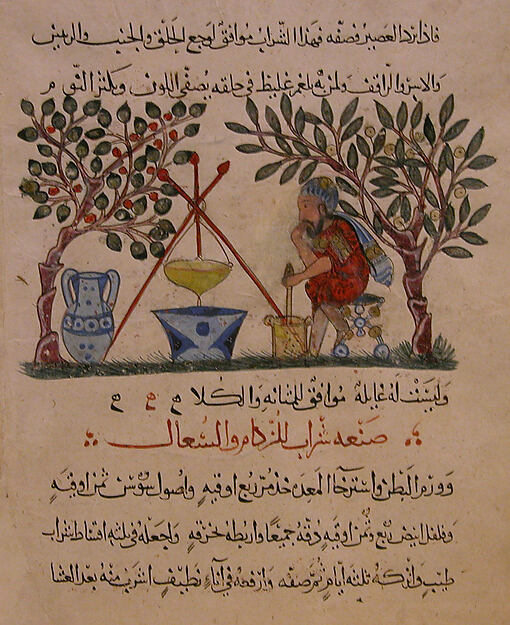
1) "Physician Preparing an Elixir", Folio from a Materia Medica of Dioscorides (Iraq; A.D. 1224)
This artwork shows a figural book painting which had started in the Islamic world as an art form in the late Abbasid Iraq of the 13th century. The translation of a Greek manuscript shows a physician making some type of medicine.

2) The audience would be people living in or near Iraq. Especially Muslims.

3) The artist is attempting to bear witness to the Iraqi culture and how medicine was first made in the earlier centuries.

4) The beauty of this artwork is that the artist used different colors in the piece and also the fact that Arabic text is included which makes it all the more unique.

5) This artist probably wasn't aware of the second artist's art making tradition since this was made before the second painting. 

6) I think non-European art does deserve to be placed in the mainstream story of art, because just like European art, non-European art beautifully shows art work from different cultures from different periods of time. 

Artwork #2

Manuscript Leaf with the Agony in the Garden and Betrayal of Christ, from a Royal Psalter

1) Manuscript Leaf with the Agony in the Garden and Betrayal of Christ, from a Royal Psalter (Great Britain A.D. 1270)

2) The audience would most likely be Europeans. Especially the Christians. 

3) The artist is attempting to bear witness psalms from the Old Testament. 

4) The artist representation of beauty in this painting is of course the different shades of colors used and how well the scenes from Christ's Passion are shown. 

5) The artist was probably aware of the other artist's art making tradition considering this was made years after the first painting. They both show two different religions. 

6)  I think European art does deserve its place in mainstream story of art because the artworks were made with different types of styles and in a different period of time. It's giving us a sense of knowledge of what is going on in the art. 

Tuesday, April 22, 2014

Homework #6

1) The way Yves Klein's Blue Cocktail relates to the metaphoric nature of food is that he uses the idea of blue cocktail to attract his viewers and to let them analyze his work. He uses the different colors of food to show his ideas and show his strengths as an artist.

2) The way the artist uses the soup cans to show post-WWII American's relationship to food was that during those times, people weren't really cooking a real meal due to the situations, so they would buy Campbell's Soup instead. People weren't so into cooking and the soup was always available to them. 

3) The bread was being used as something to attract the audience with. To make sure they had the audience's full attention. Whereas the puppet was being used to protest against political issues. 

4) In Judy Chicago's Dinner Party it showed individual seating arrangements for women only who were very important. Each plate at the seats had different designs on them as well. As for Leonardo da Vinci's Last Supper, it was showing both male and females eating and talking together. His art was focusing mainly on the people and not the plates like Judy was doing.

5) In "Theaster Gates", Sunday dinners were being held for people of different races. The artist was focusing mainly on the social interaction. He's using food as a way for people to interact with each other and learn about the others race. In "Enemy Kitchen" Rckowitz's idea is kind of similar to Theaster Gates, but the main focus was on the war. He wanted people to enjoy the food as well as talking about the war. 

6) Bozhkov had used his own picture and the picture of the bacteria on the cover of the yogurt package. The way he designed his project, he's giving us the idea of how the yogurt is being made. The product bear witnesses to the image of the artist of his existence. He's using the yogurt to share his ideas and show people his art through food. 


Cooking up a story
So, for my recipe I have decided to share a traditional yet simple recipe in my culture. It's called roti, or easier terms, pita bread. Roti is a very important food to my culture considering we use it to eat with basically all our food. Except rice of course. It's quite easy to make and I always love helping my mom make it. It's something fun to do together and it has become a tradition for us to make it whenever we are in need of it.
Ingredients
- Five cups flour
- Two cups water (or as desired)
- A pinch of salt
- A medium bowl

So, here is the starting of the process of making roti. Some simple flour. This flour is actually different than the flour we use in American cooking. In my language we call it Ata which does translate to flour in English, but it's a different type of flour you can buy from any Pakistani or Indian grocery store. 
After you have added the flour to the bowl, add the water. You don't have to add all of it. It depends on you and what you think is the right consistency of the dough. 
And like any typical dough, you have to kneed it with your hands. I insisted on using my Kitchen Aid mixer to kneed the dough, but of course my mom wanted to stick to being traditional and use her hands. 
After you kneed for a few minutes and adding water, the dough finally takes its ball like shape.
Once the dough takes its shape, you have to make little round balls like this. This is the first form of the roti.
After you have rolled the dough into a ball, roll it flat with a rolling pin to get its proper round shape.
Then what my mom likes to do is use her hands to flatten it a little more and give it more of a round shape.
So, this lovely thing right here is what we use to make the roti. I'm not sure what it's called in English, but I guess we can call it a pan. It's slightly rounded to help make the roti. 
This is the next step. Placing the roti on the pan and basically just making it. It's like making pancakes in a way. Got to make sure both sides are well cooked.
This is what the roti is supposed to look like on both sides. You gotta make sure you keep your eye on it and not walk away. It only takes a few seconds to cook. 
And there you go! The traditional roti (pita bread) We like to keep it covered so it stays warm. You can honestly eat this with any Pakistani or Indian dish that you like.